
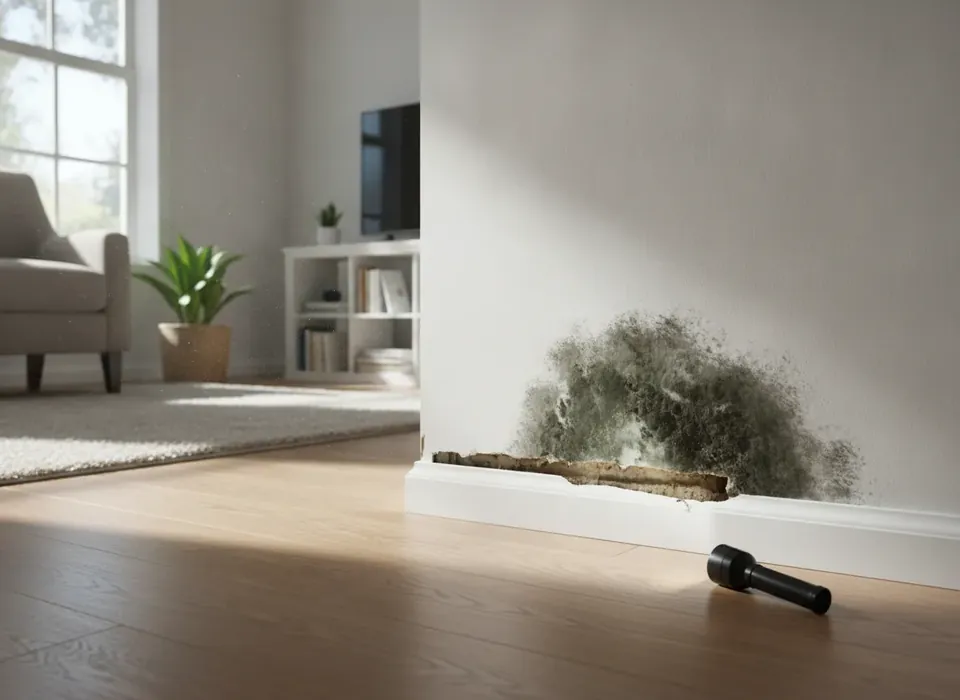
In February 2021, Winter Storm Uri pushed Dallas-Fort Worth to minus 2 degrees and held the region below freezing for 139 straight hours. Pipes burst across Plano, water demand doubled, and tens of thousands of homes went days without power. Most of those homes were dried out, patched and repainted that spring. Five and a half years later, "the house smells musty and I cannot find a leak" is a call that mold companies in Collin County still take. Hidden mold from a burst pipe in 2021 is not a documented outcome for any particular house, but it is a common scenario, and this guide explains why, where to look and what to do if you find it.
What Uri did to Plano
The facts are well recorded. The National Weather Service office in Fort Worth logged a minimum of minus 2 degrees Fahrenheit at DFW Airport on February 16, 2021, following a 93-hour freeze and then a second stretch of 139 consecutive hours at or below freezing. FEMA declared a major disaster, DR-4586, on February 19, 2021, covering Collin County. In Plano, Community Impact reported about 50,000 homes without power at the peak, more than 300 emergency water-shutoff calls between February 19 and 21, and that daily water demand doubled as residents dripped faucets and pipes burst across the city. The city council waived fees for residential plumbing permits, storage pods and construction dumping, and the city manager described a financial emergency.
Apartments took the same hit; local news reported dozens of Plano complexes losing water to burst pipes. Statewide, insurers projected losses of $10 billion to $20 billion, and at least one catastrophe modeler flagged mold claims as a factor that could push the total higher.
How to read this guide. The storm facts above are sourced. What follows about mold is building science applied to a common pattern, not a finding about your house. The only way to know is to have a TDLR-licensed assessment consultant look.
Why a 2021 leak can still be a 2026 problem
Plano homes are slab-on-grade with no basement, so the plumbing runs through the attic and the exterior walls, the spaces that froze. When a line split, water ran down inside wall cavities, soaked insulation and drywall, and pooled on the bottom plate before anyone saw a stain. The repairs that followed were done fast and in volume. Plumbers were booked for weeks, and many homeowners cut a hole, fixed the pipe, ran a fan and patched the hole.
That dries the room side, not always the cavity. Wet fiberglass, a soaked bottom plate and the paper on the back of drywall can stay damp long enough for mold to establish, and the summer does the rest: DFW dew points sit in the mid-60s for months and the attic runs at outdoor humidity. Once the material finally dries, the growth goes dormant behind the paint. It does not go away.
The signal, when there is one, is usually a smell with no source: a closet on an outside wall, a bedroom under an attic plumbing run. Sometimes it is a faint tide line painted over. Sometimes nothing shows until a remodel opens the space.
Where to look
| Location | Why it froze | What to check now |
|---|---|---|
| Attic plumbing runs and attic water heaters | Attics in slab homes are the coldest indoor space and carry supply lines in many 1990s and 2000s two-story homes | Ceiling stains under the runs, compressed or discolored insulation, sagging drywall, a musty smell when the attic hatch opens |
| Exterior-wall supply lines | Hose bibs and lines feeding kitchens and baths on outside walls had the least insulation between them and the cold | Baseboard swelling, bubbling paint low on the wall, soft drywall behind furniture |
| Tub and shower walls on outside walls | Valves and risers sit in the cavity with little heat | Smell in the bathroom with no visible leak, loose tile, a damp cabinet floor beside the tub |
| Ceilings under second-floor baths | Frozen supply lines upstairs drained through the floor | Repainted ceiling patches, a stain that keeps returning through new paint |
If you bought the home after 2021, Texas sellers must hand over any Certificate of Mold Damage Remediation issued in the previous five years. A house that had licensed mold work after Uri should have come with one. A house that only had a plumber and a patch will not, which tells you nothing either way about the cavity.
What to do if you suspect it
Find the water first
Rule out a live leak before blaming 2021. Check the water meter with everything off, look at the attic AC drain pan and condensate line, and check the roof after rain. A current leak changes the whole job.
Get a licensed assessment
A TDLR-licensed mold assessment consultant uses a moisture meter and, where needed, a borescope or air sampling to find what is behind the finish. This is the situation where an assessment earns its fee: EPA says sampling is usually unnecessary when mold is visible, and here nothing is visible. Published national ranges for inspection run $303–$1,044, with lab fees of $250–$350 if samples go out.
Size the problem honestly
Under 25 contiguous square feet, you may open and clean it yourself or hire anyone. At 25 square feet or more, Texas requires a licensed remediation contractor, separate from the assessor, with a written protocol, a TDLR notification, containment, clearance and a certificate within 10 days. A single wet stud bay that runs floor to ceiling can cross that line.
Open, remove, dry, clear
The remediation contractor removes the affected drywall and insulation under containment, cleans the framing, dries the cavity and then the assessor passes clearance before the wall is closed. Rebuild is a separate trade, and replacing walls needs a Plano permit from a registered contractor.
What the companies do on a burst-pipe job, including the emergency notification rule for active water damage, is on the burst pipe and water damage mold page, and the assessment side is on the mold inspection and testing page.
Insurance, five years on
Many Plano households filed a Uri claim in 2021 and closed it that year. Mold found now raises a question only your insurer can answer, so ask them rather than relying on anyone else. Texas policies generally cover sudden and accidental water discharge, which a burst pipe is, and generally do not cover continuous leaks or neglect. Most policies do not pay to remove mold except as part of repairing covered damage, and many cap or exclude mold remediation unless you bought an endorsement. The TDI-approved endorsement wording asks you to report a hidden loss within 30 days of when you detected or should have detected it, which is a reason to call the day the assessor finds something rather than after the repair. If licensed work is done, the Certificate of Mold Damage Remediation keeps the loss from being used against you at renewal under Insurance Code 544.303; our certificate guide explains how.
Before the next freeze
Attic pipes freeze at the same temperatures they did in 2021. Insulate exposed attic and garage lines, know where the house shutoff is, and if a pipe does burst, get the cavity opened and dried within EPA's 24 to 48 hour window rather than patched over. Typical costs for assessment and remediation are on the Plano mold remediation cost page.
Frequently asked questions
Can a pipe that burst in February 2021 still cause mold today?
It is a common scenario. A wall cavity or attic insulation that got wet, was dried from the outside and then closed up can hold moisture long enough for mold to grow and then go dormant behind the finish. Whether that happened in a given home is unknown until a licensed assessor checks with a moisture meter, so treat it as a possibility to rule out, not a certainty.
Where should I look for hidden mold from a frozen pipe?
Where the pipes are: attics with plumbing runs or an attic water heater, exterior walls carrying supply lines, the cavities behind tubs and showers on outside walls, and the ceilings under any attic pipe. Look low on walls for baseboard swelling and bubbling paint, and look up for faint ceiling stains and sagging drywall.
Do I need mold testing if I smell something but see nothing?
Possibly, and this is one of the cases where it earns its fee. EPA says sampling is usually unnecessary when mold is visible, but a musty smell with no visible source is exactly what a licensed mold assessment consultant with moisture mapping and, if needed, air samples is for. TDLR notes that identifying the species is usually not required.
Is a 2021 storm claim still open for mold found now?
Probably not, and it is a question for your insurer, not for this site. Texas policies generally cover sudden and accidental water discharge, and endorsement wording asks you to report a hidden loss within 30 days of when you detected or should have detected it. If you find damage now, document it and call your insurer promptly; never assume coverage either way.
Want numbers from companies that work in Plano and Collin County? Request free quotes or call (972) 472-8749. Plano Mold Experts is a free quote service, not a mold company or a licensee; independent, TDLR-licensed Texas companies reply to you directly.